Welcome to the grand theater of Washington D.C., where the lights are always bright, the microphones are always live, and the plot twists come faster than a caffeine-fueled intern on a Monday morning. In our latest episode of "As the Capital Turns," we find ourselves looking at a whirlwind of words, timelines, and some very skeptical side-eye coming from the newly minted corridors of power. The star of our skepticism today is none other than Representative Maggie Goodlander, who has found herself in the middle of a rhetorical hurricane involving some very big claims about international relations and the ever-shifting sands of global conflict.
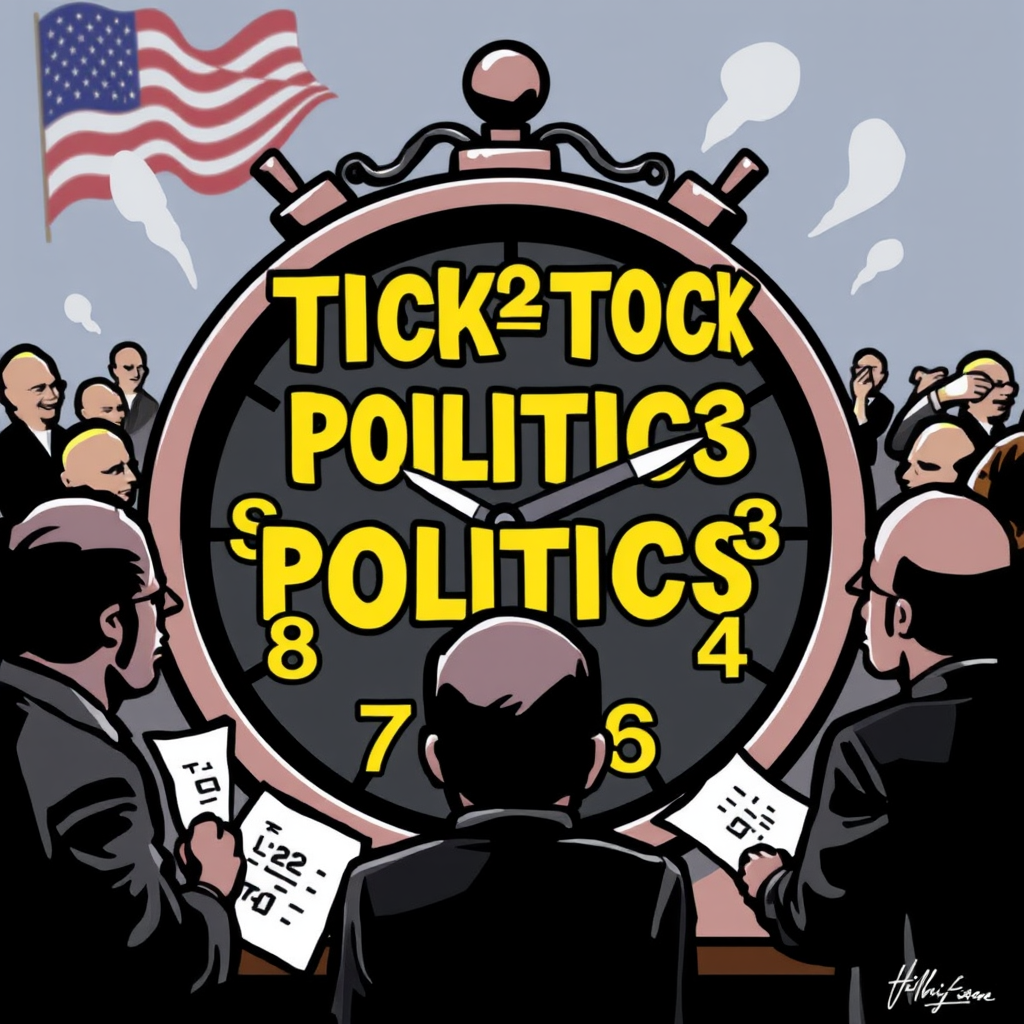
Imagine, if you will, a giant cosmic clock. On this clock, the hands don't move in circles; they jump around like a grasshopper on a hot sidewalk. This seems to be the vibe lately when it comes to discussions regarding Iran and the potential for "what might have been" or "what could be." One moment, we are hearing that a major conflict was just minutes away, and the next, it seems the timeline has shifted back into the mists of history. Goodlander, with the sharp focus of someone who has spent her fair share of time in high-stakes legal and national security circles, isn't exactly buying a ticket to this particular show. In fact, she’s essentially asking if anyone actually has a map for this journey, or if we’re just driving toward the horizon with a blindfold on.
The core of the hullabaloo revolves around the former commander-in-chief and his penchant for storytelling that rivals the most dramatic of cliffhangers. According to the chatter coming from the campaign trail, there are assertions that the world was on the brink of something truly massive, only for the narrative to pivot whenever the wind changes direction. Goodlander has pointed out that trying to keep up with these shifting timelines is a bit like trying to catch a greased pig at a county fair—entertaining for the onlookers, perhaps, but ultimately exhausting and a little bit messy for everyone involved. She’s made it quite clear that when the story changes as often as a teenager changes their profile picture, it becomes very hard to take the core message seriously.
It’s a classic case of the "Boy Who Cried Wolf," but in this version, the wolf is a complex geopolitical entity and the boy is standing on a literal stage with a very loud sound system. Goodlander’s perspective is that foreign policy isn't supposed to be a Choose Your Own Adventure book where you can just flip back to page forty-two if you don't like how the ending is shaping up. When you are talking about things as serious as war and peace, the details actually matter. You can't just throw out dates and scenarios like you're calling numbers at a high-stakes bingo game and expect the world to nod along in agreement.
There is also the matter of the "razzmatazz" factor. In the world of modern politics, making a big, bold claim is often more important than whether that claim can actually be backed up by a calendar or a set of meeting minutes. Goodlander seems to be acting as the unofficial fact-checker of the neighborhood, peering over the fence and asking, "Wait, did that actually happen on Tuesday, or are we just pretending Tuesday was a different day this week?" It’s a tough job, especially when the person making the claims is a master of the theatrical flourish. It’s like trying to explain the laws of physics to a magician who is currently pulling a rabbit out of a hat; the audience is distracted by the ears and the whiskers while the logic is hiding in the velvet lining.
Beyond the playful jabs at the inconsistent storytelling, there is a deeper layer of concern that Goodlander is tapping into. When leadership involves a constant stream of "I almost did this" or "they were going to do that," it creates a fog of uncertainty that can be felt all the way across the ocean. International relations usually rely on a certain level of predictability—a "if this, then that" sort of logic. When that logic is replaced by a "maybe this, but also that, and definitely something else" approach, the global community starts looking for the exit signs. Goodlander is highlighting the fact that this isn't just a fun game of political ping-pong; it has real-world consequences for how allies and adversaries view the stability of the American word.
As the debate rages on, it’s clear that we are living in an era where the narrative is king, even if the king is wearing a very confusing set of clothes. Goodlander’s insistence on taking things seriously serves as a reminder that behind the slogans and the rallies, there are actual policies and actual people whose lives are affected by these decisions. She’s essentially the person at the party who stops the music to ask if anyone actually knows where the snacks are, while everyone else is busy dancing to a song that nobody actually recognizes. It’s a necessary, if sometimes unglamorous, role to play in the grand pageant of democracy.
So, where does this leave us? We are left watching a high-speed chase between reality and rhetoric. On one side, we have the bold assertions of a leader who loves to keep everyone guessing. On the other side, we have representatives like Goodlander who are holding up a magnifying glass and asking for a bit more clarity. It’s a spectacle, a drama, and a comedy all rolled into one, played out on the world stage for an audience of millions. Whether the timelines will ever actually align remains to be seen, but for now, we can all enjoy the fireworks while Goodlander keeps her hand firmly on the fire extinguisher, just in case things get a little too "creative" with the truth.
Ultimately, the dance of the diplomats and the sparring of the politicians will continue. As long as there are microphones to speak into and voters to persuade, the stories will keep getting bigger and the timelines will keep getting twistier. But as long as there are voices like Goodlander’s calling for a return to the facts, there will always be a bit of gravity to hold the whole balloon down to earth. And in a town like Washington, a little bit of gravity goes a long way toward keeping everyone from floating off into the clouds of pure imagination.